

Sellers need one thing from a cash buyer before they’ll pull a listing off the market: a current, verifiable document showing liquid funds equal to or above the purchase price, plus a small buffer for closing costs. That document is called a proof of funds (POF), and it must show three things immediately: the account holder’s full legal name matching the purchase contract, the financial institution’s name on official letterhead or a statement header, and a date confirming the funds are recent. A recent bank statement or a formal bank-issued letter usually covers all three.
Key Takeaways
| Point | Details |
|---|---|
| Recency matters most | Statements or letters dated within 30 days are the standard; refresh before every new offer. |
| Show a closing-cost buffer | Display 1%–3% above the purchase price to cover title, escrow, and transfer fees. |
| Bank letter beats a statement | A formal bank letter on letterhead with an officer’s direct phone number speeds seller verification. |
| Redact before sharing | Hide full account numbers and SSNs; keep name, institution, balance, and date visible. |
| Comparespot for local buyers | Comparespot ranks vetted Metro Detroit cash buyers editorially, with no paid placements. |
Table of Contents
- What is proof of funds and why do sellers ask for it?
- Which documents qualify as proof of funds for a cash buyer?
- What should a proof-of-funds bank letter include?
- How do you get a proof-of-funds letter from your bank?
- When should you submit proof of funds and how long is it valid?
- How do sellers and agents verify proof of funds?
- How do you handle gifts, joint accounts, and liquidated investments?
- How do you share proof-of-funds documents securely?
- Common mistakes cash buyers make with proof of funds
- Expert tips and a pre-submission checklist
- Comparespot ranks the best local cash buyers in Metro Detroit
- Sources
- FAQ
What is proof of funds and why do sellers ask for it?
A proof of funds document confirms that liquid cash is sitting in an account right now, available to close without a lender’s approval. It is not a pre-approval letter, a credit score, or a promise. It is evidence that the money exists and can move.
Sellers ask for it because accepting a cash offer means taking the home off the market. That is a real cost. If the deal falls through, they lose days or weeks of exposure. Sellers prioritize offers with clear, current, verifiable proof of funds because it materially reduces the risk the transaction collapses.
Two concerns drive most POF requests:
- Financing fall-through risk. Even buyers who say they are paying cash sometimes plan to use a hard-money loan or a line of credit. A POF letter from a bank eliminates that ambiguity.
- Assignment or wholesaling intent. Some buyers plan to assign the contract to a third party rather than close themselves. A POF tied to the buyer’s own account signals they intend to close personally.
Which documents qualify as proof of funds for a cash buyer?
Acceptable proof of funds includes current checking or savings statements, money market accounts, brokerage cash accounts with settled funds, and a formal bank-issued POF letter. Margin accounts, retirement accounts, home equity lines, and raw cryptocurrency wallets generally do not qualify without conversion and settlement into a liquid USD account.
Here is a quick breakdown of the most common document types:
- Recent bank statement (checking or savings): The most widely accepted option. Fast to produce, easy to verify, and universally recognized. Downside: it shows your full transaction history unless you redact it carefully.
- Bank-issued POF letter: A formal letter on bank letterhead confirming your balance. More polished than a statement and easier to share without exposing transaction details. Takes one to two business days to obtain.
- Brokerage cash or money market account statement: Acceptable when the cash is settled and not tied up in pending trades. Sellers may ask for confirmation the funds are liquid.
- Cashier’s check or escrow-ready wire confirmation: Useful for showing you are ready to move immediately, but less common as a standalone POF document.
Pro Tip: If you are making multiple offers across different properties, request a bank letter with a balance range rather than a specific dollar amount. This lets you use the same letter for offers at different price points without revealing your exact balance every time.
What should a proof-of-funds bank letter include?
A bank letter that is missing even one key element will trigger a verification call or, worse, a rejection. Here is exactly what the letter needs:
- Bank letterhead with the institution’s full name, address, and main phone number
- Your full legal name as the account holder (matching the purchase contract exactly)
- Account type (checking, savings, money market)
- Current available balance as of the date of issuance
- Date of issuance (must be recent, typically within 30 days)
- Authorized bank officer’s full name, title, and a direct phone number
- Officer’s signature
When you call or visit your bank, use language like this:
- “I need a proof-of-funds letter on bank letterhead confirming my available balance as of today for a real estate purchase.”
- “Please include the issuing officer’s direct phone number so the seller’s agent can verify.”
- “I need the letter dated today and signed by an authorized officer.”
Banks typically produce a formal POF letter within one to two business days for standard personal accounts. Business accounts or high-dollar verifications may take longer and sometimes require additional documentation.
Pro Tip: Ask the bank officer directly whether they will accept a verification call from a seller’s agent. Most will. Knowing this in advance lets you tell the listing agent upfront, which removes one of the most common friction points in cash offer review.
How do you get a proof-of-funds letter from your bank?
Follow these steps to get a clean, usable letter quickly:
- Gather your ID and account information. Have your government-issued ID, account number, and the approximate purchase price ready before you contact the bank.
- Contact your branch or use the bank’s online request feature. Many major banks (Chase, Bank of America, Wells Fargo) allow POF letter requests through their secure messaging portals. Smaller community banks and credit unions usually prefer an in-branch or phone request.
- Specify the amount and the property purchase date. Tell the officer the purchase price and your target closing date so the letter reflects the right balance and timeline.
- Request the officer’s contact information and a dated signature. This is the step most buyers skip. A letter without a named, reachable officer is harder to verify and easier to dismiss.
- Receive the letter as a PDF and redact as needed before sharing.
What to say on the phone or in a secure message: “I’m purchasing a property for approximately $[amount] and need a proof-of-funds letter on bank letterhead showing my available balance as of today, signed by an authorized officer with their direct contact information.”
Before you send the letter to anyone, run through this redaction checklist:
- Hide: Full account number (keep only the last four digits), Social Security number, any unrelated account details
- Keep visible: Account holder name, institution name and logo, available balance, date of issuance, officer name and contact
Turnaround is typically same day to two business days for personal accounts. If you are working with a business account or recently transferred a large sum, budget an extra day or two.
When should you submit proof of funds and how long is it valid?
Submit your POF at the same time as your signed offer. Sending it separately, or waiting until the seller asks, signals hesitation and slows the process.
On validity, most agents expect statements or letters dated within 30 days of the offer. Some accept up to 60 days, particularly for lower-value transactions. High-value deals or competitive markets may require a fresh bank letter dated within seven days.
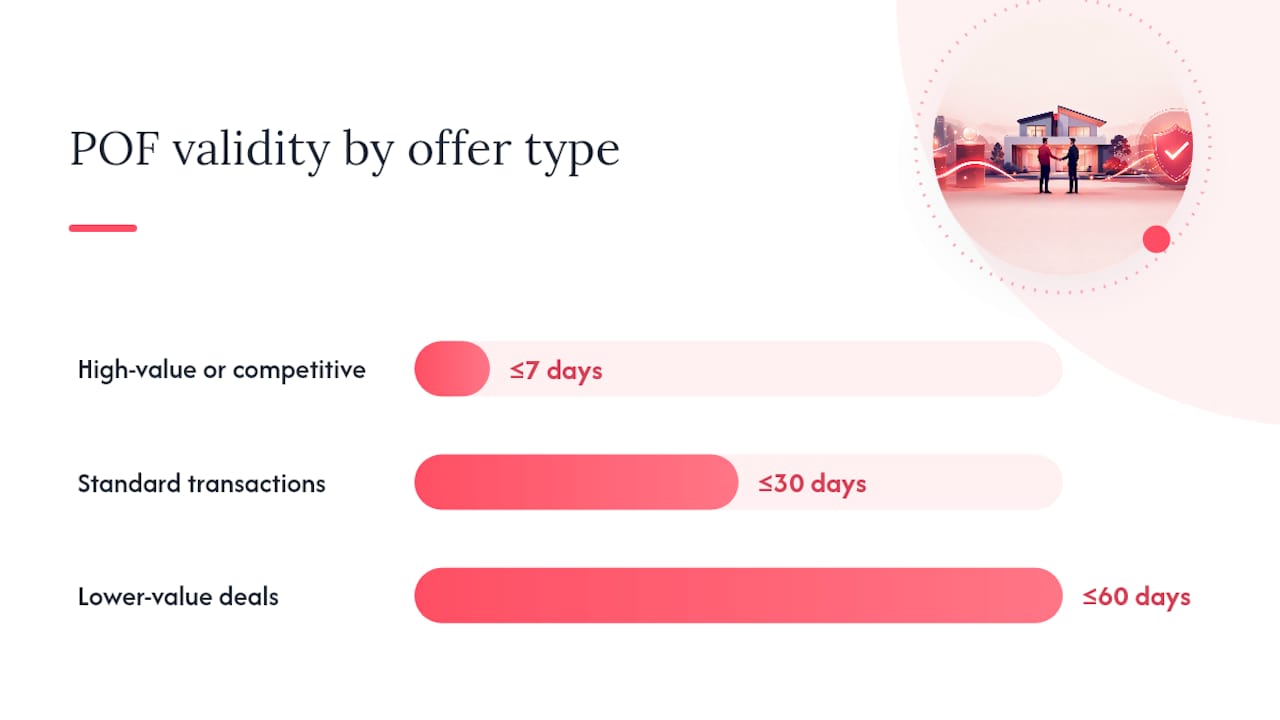
| Validity Window | When It Applies | Recommended Action |
|---|---|---|
| Within 7 days | High-value or competitive offers | Request a new bank letter immediately before submitting |
| Within 30 days | Standard expectation for most transactions | Refresh if your current document is older |
| Within 60 days | Lower-value deals or some seller preferences | Acceptable in some markets; confirm with the listing agent |
| Older than 60 days | Generally not accepted | Request a new statement or letter before submitting |
Buyers should show a buffer of 1%–3% above the purchase price to cover closing costs such as title insurance, escrow fees, and transfer taxes. If your offer is $300,000, your POF should show at least $303,000–$309,000 in available funds. Showing exactly the purchase price and nothing more raises a quiet concern: where does the money for closing come from?
Cash buyers still pay closing costs. Title insurance, escrow fees, recording fees, and transfer taxes add up. Showing a balance that covers only the purchase price tells a careful seller you may come up short at the table.
How do sellers and agents verify proof of funds?
Experienced listing agents run through four checks on every POF document they receive:
- Date check: Is the document dated within the expected window? Anything older than 30 days gets flagged immediately.
- Amount check: Does the balance meet or exceed the offer price plus a reasonable buffer?
- Institution verification: The agent calls the bank at its publicly listed phone number, not the number on the POF letter, to confirm the account exists and the balance is accurate. This phone-call verification is one of the most effective ways to detect fraudulent letters.
- Formatting and metadata check: Agents look for signs of editing: inconsistent fonts, misaligned logos, PDF metadata showing the document was modified after creation.
Red flags that will kill or delay your offer:
- Round-number balances (exactly $500,000.00 with no cents)
- Edited or altered PDFs
- Name on the document does not match the name on the contract
- Gift-only deposits with no paper trail
- Third-party temporary “POF” services that park money briefly to inflate a balance
- Assignment or wholesale intent that is not disclosed upfront
Pro Tip: Attach the bank officer’s direct phone number in the body of your offer email, not just on the letter. It signals confidence and cuts the verification step from hours to minutes.
Wire fraud warning: Never wire earnest money or closing funds to an individual’s personal account. All wires should go to a licensed title company or escrow agent at a verified address. Confirm wiring instructions by phone with the title company directly before sending any funds.
How do you handle gifts, joint accounts, and liquidated investments?
Non-standard cash sources require extra documentation. Here is what each situation needs:
- Gifts: A signed gift letter naming the donor, their relationship to you, the dollar amount, and a clear statement that no repayment is expected. Pair it with evidence of the transfer: a copy of the donor’s check or a bank transfer confirmation. Sellers and title companies commonly request this documentation to confirm the funds are not a loan.
- Joint accounts: The name on the account must match the name on the purchase contract. If only one account holder is buying, you may need a co-owner consent letter or a statement showing the funds are available to the purchasing party alone.
- Liquidated investments: Brokerage trades settle on a T+2 timeline, meaning proceeds from a stock or fund sale may not be available for two business days after the trade executes. Sellers may ask for a settled-cash confirmation or a cashier’s check rather than a brokerage statement showing a pending settlement.
- Cryptocurrency: Convert to USD in a regulated exchange (Coinbase, Kraken) and let the funds settle into a standard bank account before presenting POF. Show both the conversion record and the settled bank statement.
| Source | Extra Document Required | Key Timing Issue |
|---|---|---|
| Gift funds | Signed gift letter + transfer evidence | Funds must be in your account before closing |
| Joint account | Co-owner consent (if needed) | Name must match contract |
| Liquidated investments | Settled-cash bank statement | T+2 settlement; allow 2 business days |
| Cryptocurrency | Conversion record + settled bank statement | Exchange processing time varies |
Pro Tip: For complex fund sources, provide both the original source statement and the settled-cash bank statement. This creates a clear paper trail linking the money to you and eliminates the most common follow-up question.

For investors exploring self-financing real estate scenarios, the documentation requirements follow the same logic: show where the money came from and confirm it is liquid and settled.
How do you share proof-of-funds documents securely?
Sharing financial documents carries real privacy risk. Follow this process:
Redaction checklist before sharing:
- Remove your full account number (leave only the last four digits)
- Remove your Social Security number if it appears anywhere
- Keep visible: your full legal name, institution name and logo, available balance, and date
- Keep the last four account digits so the institution can confirm the account if called
Secure transfer steps:
- Use the encrypted document portal your real estate agent or title company provides, not a personal email attachment.
- If email is the only option, use a password-protected PDF and send the password in a separate message.
- Never send financial documents to an email address you cannot independently verify. Confirm the recipient’s address by phone before sending.
- Do not use text message or social media to share any document containing account information.
The FTC recommends limiting shared personal data and using secure channels when sending financial documents to reduce exposure of sensitive personal information.
Common mistakes cash buyers make with proof of funds
Most POF problems are avoidable. These are the ones that stall or kill offers most often:
- Stale statements. A bank statement from 45 days ago looks like you are hiding a recent change in your balance. Refresh it.
- Name mismatch. The name on your POF must match the name on the purchase contract exactly. A middle initial difference can trigger a verification request.
- Non-liquid assets. Showing a retirement account or a home equity line as your primary POF signals you do not have the cash ready. Sellers notice.
- Refusing verification calls. Telling a seller’s agent the bank “won’t take calls” raises immediate suspicion. Most banks will verify; if yours will not, explain why in writing.
- Third-party temporary POF services. These services briefly move money into an account to inflate a balance. Experienced agents recognize the pattern and will reject the offer or demand additional documentation.
- Underestimating closing costs. Showing exactly the purchase price with no buffer suggests you have not accounted for title insurance, escrow, and transfer fees.
| Do | Don’t |
|---|---|
| Refresh your statement or letter within 30 days of each offer | Submit a document older than 30–60 days |
| Match your legal name exactly to the contract | Use a nickname or abbreviated name |
| Disclose gift funds early with a signed letter | Surprise the seller with gift funds at closing |
| Allow and facilitate verification calls | Block or discourage agent verification |
| Show a 1%–3% buffer above the purchase price | Show only the exact purchase price |
Expert tips and a pre-submission checklist
A few habits separate buyers whose offers move fast from those who spend days answering follow-up questions.
- Pre-request your POF letter before you start making offers. If you are actively shopping, keep a fresh PDF ready to attach to any offer within minutes.
- Attach the POF to the same email as the signed contract. Sending them separately creates a paper trail that is harder to track and signals disorganization.
- Include the bank officer’s direct phone number in the body of your offer email. Agents appreciate not having to hunt for it.
- Be ready to wire earnest money to a neutral escrow account quickly. Speed after acceptance is as important as the offer itself.
- For cash buyers in Metro Detroit, local agents in Wayne, Oakland, and Macomb counties often expect POF dated within 30 days and may request a fresh letter for offers above $400,000.
Pre-submission checklist:
- Government-issued ID matches the name on the purchase contract
- Bank letter or statement dated within 30 days
- Balance shows purchase price plus 1%–3% buffer
- Full account number redacted; last four digits visible
- Bank officer name and direct phone number included
- Settled-cash confirmation attached if funds were recently liquidated
- Gift letter and transfer evidence attached if any funds are a gift
- Document sent via encrypted portal or password-protected PDF
Pro Tip: If you plan to make offers on multiple properties, ask your bank for a letter that states “available funds in excess of $[amount]” rather than an exact balance. This protects your privacy and remains valid across a range of offer prices.
Understanding how POF differs from a mortgage pre-approval is worth a quick read if you are new to cash transactions. A mortgage pre-approval is a lender’s conditional commitment to loan money; a POF letter is evidence the money already exists in your account. They serve different purposes and are not interchangeable.
The one habit that actually protects your offers
Most closing failures tied to proof of funds come down to a single avoidable problem: a buyer submits documentation that was accurate three weeks ago and has since changed. A balance that dropped after a large expense, a statement that aged past the 30-day window, a letter that was never refreshed after a previous offer fell through. These are not fraud issues. They are preparation failures.
The fix is one habit: treat your POF like a perishable document. Refresh it before every new offer, not once at the start of your search. If you are actively house hunting, set a calendar reminder every 25 days to download a fresh statement or request a new bank letter. That single routine eliminates the most common reason cash offers get held up or questioned.
Sellers and their agents are not trying to make your life difficult. They are protecting themselves from a deal that looks solid on paper but falls apart at closing. A current, clean, verifiable POF document is the fastest way to tell them: this one will not.
Comparespot ranks the best local cash buyers in Metro Detroit
Finding a vetted cash buyer in Metro Detroit does not have to mean sorting through unverified listings or cold-calling investors. Comparespot publishes independently researched, editorially ranked lists of the top cash home buyers in Metro Detroit across Wayne, Oakland, and Macomb counties, based on real transaction data and customer sentiment analysis. No paid placements. No guesswork.

Whether you are selling a home in a time-sensitive situation or looking to compare your options before accepting an offer, Comparespot gives you a clear, ranked view of who operates in your area and how they perform. Check the top-rated local cash buyers and real estate agents on Comparespot and connect with a provider who can move at your pace.
Sources
- How to Show Proof of Funds to Buy a House With Cash - LegalClarity
- Proof of Funds Verification Guide | Own Luxury Homes®
- Proof of funds: Demonstrating financial support - The Detroit Bureau
- Trade settlement: Why you need to understand the T+2 timeline | SEC
This article is general information, not a substitute for advice from a qualified financial advisor. Consult a qualified financial professional about your own circumstances before acting on anything here.
FAQ
How do cash buyers show proof of funds?
Cash buyers typically submit a recent bank statement or a formal bank-issued letter on letterhead showing a balance equal to or above the purchase price. The document should be dated within 30 days and include the account holder’s name, institution name, and a verifiable balance.
What documents are accepted as proof of funds for a home purchase?
Checking and savings account statements, money market account statements, brokerage cash account statements (with settled funds), and bank-issued POF letters all qualify. Retirement accounts, home equity lines, and unconverted cryptocurrency wallets generally do not.
Is it normal for a seller to ask for proof of funds?
Yes, it is standard practice. Sellers ask because accepting a cash offer means removing the property from the market, and they need confidence the buyer can close. Offers submitted without a verifiable POF are often ignored or deprioritized.
How do you show proof of funds for a property purchase?
Request a formal letter from your bank on letterhead, or download your most recent account statement. Redact your full account number, attach the document to your offer, and include the bank officer’s direct phone number so the listing agent can verify quickly.