
Book your movers 4 to 8 weeks out, confirm your utility hookups two to three weeks before move day, and finish your essentials box the weekend before the truck arrives. That’s the whole game in one sentence, but the details matter. Before you sign anything, ask a mover for its Michigan CVED number if the move stays in-state, or its USDOT number if you’re crossing state lines, and never accept a quote that skips a physical or video walkthrough of your home.
- Book professional movers 4 to 8 weeks ahead, especially for spring or summer dates
- Schedule DTE Energy and DWSD service transfers as soon as your move date is locked
- Declutter room by room and start a moving binder for receipts and inventory
- Pack a 24 to 48 hour essentials box: medications, chargers, documents, one change of clothes
- Confirm parking, loading zone access, or elevator reservations in writing with your building manager
- File your USPS change of address within 30 days of moving
A quick benchmark: local moving guides suggest booking movers 4 to 8 weeks in advance is the single biggest lever against last-minute stress, since Detroit’s warm-weather months book up fast. Success on move day looks simple: the truck shows up on schedule, DTE and DWSD are both active before you unlock the front door, and you’re not digging through 40 boxes to find your toothbrush.
Key Takeaways
A successful Detroit move comes down to early mover verification, on-time utility activation through DTE and DWSD, and a winter buffer plan when the calendar demands it.
| Point | Details |
|---|---|
| Book movers early | Reserve professional movers 4 to 8 weeks ahead, especially for spring and summer dates. |
| Verify credentials first | Confirm a Michigan CVED number for in-state moves or a USDOT number for interstate moves. |
| Schedule utilities immediately | Start DTE and DWSD service requests as soon as your move date is confirmed. |
| Get access in writing | Confirm elevator reservations, loading zones, or street permits with your building manager. |
| Build a winter buffer | Add a buffer day and a small contingency budget for moves between November and March. |
Table of Contents
- Your Detroit Moving Checklist Starts 8 to 6 Weeks Out
- Schedule Utilities and Confirm Building Access 4 to 3 Weeks Out
- Two Weeks to One Week Out: Lock Down the Details
- Move Day, Step by Step
- Don’t Forget These Tasks After You Unpack
- Packing Smart and Planning for a Detroit Winter Move
- Where to Find Vetted Local Providers for Your Move
- How Detroit Weather Shapes Your Moving Timeline
- Detroit Moving Restrictions and When Movers Get Booked Solid
- Managing Parking and Traffic on Detroit Moving Day
- Getting Rid of What You Don’t Need Before You Pack It
- What Actually Matters Most in a Detroit Move
- Sources
- FAQ
Your Detroit Moving Checklist Starts 8 to 6 Weeks Out
This is the window where the real savings happen, not the week before the truck shows up. Rushed decisions at week two cost money. Careful ones at week eight save it.
- Get at least three written estimates, each based on a video or in-person walkthrough of your belongings. A mover who quotes you over the phone without seeing your stuff is guessing, and that guess tends to grow once the truck is loaded and you’re negotiating from a position of zero leverage.
- Ask every mover for their credentials before you ask about price. Intrastate movers need a Michigan CVED number issued by the Michigan State Police Commercial Vehicle Enforcement Division. If you’re moving from out of state, the company needs a USDOT number you can verify through FMCSA. Skip this step and you have no recourse if something goes wrong.
- Lock in your date now. Detroit-area movers get booked solid during spring and summer, and waiting until three weeks out often means settling for whoever still has an opening, not whoever you actually vetted.
- Declutter with a three-pile system: sell, donate, toss. Furniture you haven’t used in a year isn’t coming with you emotionally either, so stop paying to move it.
- Start a moving binder. One folder, physical or digital, for estimates, lease or closing documents, inventory photos of anything valuable, and receipts for deductible moving costs.
- Research your new neighborhood before signing anything. Wayne, Oakland, and Macomb counties differ sharply on property tax rates, school district boundaries, and even trash pickup schedules, so what works two miles away might not apply to your new address.
- Notify schools and employers now so records transfer smoothly and there’s no gap in your kid’s enrollment or your first paycheck at a new job.
Pro Tip: Check a mover’s complaint history on the Better Business Bureau before you check their price. A cheap quote from a company with a stack of unresolved complaints isn’t a deal, it’s a risk you’re paying for later.
Schedule Utilities and Confirm Building Access 4 to 3 Weeks Out
This is the administrative middle stretch, less exciting than packing, more consequential if you skip it. Every task here is about making sure your new place actually functions the moment you walk in.
- Start your DWSD water transfer as soon as your move date is confirmed. The Detroit Water and Sewerage Department handles activation and transfer requests, and older infrastructure in parts of the metro area can mean processing delays if you wait until the last minute.
- Set up DTE Energy for gas and electric on the same timeline. Don’t assume the previous tenant’s service carries over. It doesn’t.
- Call your internet and cable provider now, not the week of. Installation appointments routinely book out one to two weeks, and nobody wants their first night in a new house without WiFi.
- Confirm elevator reservations and loading zone access in writing if you’re moving into a high-rise or a building with restricted street parking. Email your building manager or the leasing office; a verbal “yes, that should be fine” from someone at the front desk is not a permit.
- Check whether your street requires a loading permit. Some Detroit neighborhoods, especially near downtown and Midtown, require temporary no-parking permits from the city for moving trucks, and getting one same-day is rarely possible.
- Photograph and log high-value items like art, electronics, and antiques before the movers ever touch them. This protects you if something goes missing or gets damaged.
- Ask about specialty handling now if you own a piano, hot tub, or gun safe. Not every general mover carries the equipment for it, and specialty crews book separately from standard moving slots.
- Line up short-term storage if your closing date and move-in date don’t line up. A one-month storage unit costs far less than the stress of living out of your car for two weeks.
Two Weeks to One Week Out: Lock Down the Details
This is where the checklist gets physical. Boxes, labels, and confirmations, in that order.
- Pack room by room, not category by category. It’s tempting to pack “all the books” in one pass, but movers unload faster and you unpack faster when boxes match destination rooms.
- Label every box with its destination room and a one-word contents summary, written on the side, not the top, since boxes get stacked.
- Build your essentials box now, not the morning of. Include medications, phone chargers, a change of clothes for each person, important documents from your moving binder, and basic cookware so you’re not eating takeout off paper plates for three days.
- Call your mover to reconfirm the written estimate, crew size, and arrival window. Get any add-on charges, like extra flights of stairs or bulky-item fees, in writing before the truck pulls up.
- Withdraw cash for tips. Most crews expect $20 to $40 per mover for a full day of work, and having it ready avoids an awkward scramble at the end.
- Defrost your refrigerator 24 to 48 hours before the move. A fridge that’s still frosted over is heavier, messier, and a genuine hazard on a dolly.
- Arrange child care or pet care for move day itself. A toddler or an anxious dog underfoot while a crew hauls a couch down narrow stairs is a recipe for someone getting hurt.
Move Day, Step by Step
Move day rewards preparation, not improvisation. Walk through the plan once with your movers before anyone lifts a single box.
- Walk the Team Leader through your home first. Point out what stays and what goes, flag anything fragile, and confirm the inventory list matches what’s actually in the house.
- Ask about floor and doorway protection before loading starts. Runners on hardwood and pads on door jambs prevent damage disputes you don’t want to have after the truck pulls away.
- Keep your keys, wallet, documents, and essentials box in your own vehicle, never on the truck. If the truck runs late or takes a detour, you’re not stranded without your ID or your kid’s inhaler.
- Do a final walkthrough of every closet, cabinet, and drawer before the crew leaves the old address. Check the attic and garage too; that’s where things get forgotten.
- Do a matching walkthrough at the new address as items come off the truck, checking them against your inventory sheet.
- Report any damage or missing items while the crew is still on-site. Once they’ve left, your leverage to resolve it drops significantly.
Pro Tip: Take a two-minute video of every room before movers arrive, narrating out loud what’s already damaged. It costs you nothing and settles disputes about pre-existing scratches in about ten seconds.
Don’t Forget These Tasks After You Unpack
The truck leaving doesn’t mean you’re done. Several deadlines start ticking the moment you’re in the new place.
- Update your driver’s license and vehicle registration through the Michigan Secretary of State within 30 days of establishing residency. New Michigan residents need to complete this fairly promptly, and driving on an out-of-state license past that window can create headaches at renewal or during a traffic stop.
- File your USPS change of address so mail doesn’t pile up at your old place.
- Update your bank, insurance, and subscription billing addresses. Insurers in particular sometimes adjust rates based on your new zip code, so this isn’t just paperwork housekeeping.
- Enroll kids in their new school and register to vote at your new address if you haven’t already.
- Take final utility meter readings at your old address and confirm your DTE and DWSD accounts show the correct start date at the new one.
- Return any rented moving crates, dollies, or blankets before the rental window closes to avoid extra fees.
- Leave a review for your moving crew if they did right by you. Good crews rely on word of mouth as much as any ad campaign.
Packing Smart and Planning for a Detroit Winter Move
Fragile items need more than bubble wrap. Wrap dishes vertically, like records in a crate, rather than stacking them flat, since flat stacking concentrates pressure on the bottom plates. Pack heavier items in small boxes and lighter items in large ones. A box of books at 40 pounds is manageable; a box of books plus a box of pillows crammed into one oversized carton is how movers hurt their backs and your walls get dinged on the way out.
Winter adds a layer most first-time Detroit movers don’t plan for. Build a buffer day or two into your schedule around any move planned between November and March, since snow and ice routinely push back arrival times for local movers working multiple jobs in a day. Clear your driveway and front walkway of snow and ice before the crew arrives; some companies charge extra for hauling through unshoveled paths, and all of them move slower and less safely on ice.
- Set aside a small contingency budget for weather-related delays or rescheduled dates
- Clear snow and ice from driveways, walkways, and porch steps the night before
- Ask your mover directly whether they charge extra for cold-weather floor protection
- If timing gets tight, book a week of temporary storage rather than forcing a same-day handoff
Where to Find Vetted Local Providers for Your Move
Comparespot ranks the top real estate agents, mortgage lenders, and property managers across Wayne, Oakland, and Macomb counties, using editorial research rather than paid placements. County-level differences in the metro area mean a highly rated agent in Royal Oak might not know Sterling Heights at all.
- Buying or selling around your move? Check Comparespot’s real estate agent rankings
- Need financing lined up fast? See the mortgage lender rankings
- Furnishing a new place? Browse furniture store rankings
How Detroit Weather Shapes Your Moving Timeline
Detroit’s seasons don’t just affect comfort on move day, they affect your budget and your schedule. Summer is peak moving season for a reason: warm, dry weather makes loading faster and safer, but it also means every mover in Wayne, Oakland, and Macomb counties is booked tight from June through August. If you have any flexibility, a late-spring or early-fall date often gets you better rates and more scheduling options than a July Saturday.
Winter cuts the other way. Fewer people move between December and February, so movers have more open slots and sometimes lower rates, but the tradeoff is real risk from snow, ice, and sudden temperature drops. A driveway that’s clear at 8 a.m. can be a sheet of ice by noon if a fast-moving lake-effect system rolls through, which happens often enough in Metro Detroit that it’s worth planning around rather than hoping around.
Spring brings its own headache: unpredictable rain and occasional flooding in low-lying areas, particularly near the Detroit River and older neighborhoods with aging storm drainage. If your move falls in April or May, ask your mover how they handle wet-weather loading, including tarping and floor protection, before you’re standing in a downpour watching your couch get carried across a muddy lawn.
Whatever season you land in, build in a one-day buffer. Weather delays are common enough in the Great Lakes region that treating your move date as fixed, rather than flexible by a day, sets you up for unnecessary stress.
Detroit Moving Restrictions and When Movers Get Booked Solid
Detroit doesn’t impose city-wide restrictions on when residents can move, but individual buildings and neighborhoods often have their own rules that catch people off guard. Downtown high-rises and Midtown apartment buildings frequently require advance notice, sometimes 48 to 72 hours, before they’ll reserve a freight elevator or loading dock. Show up without that reservation and you may find yourself waiting in a service hallway while another tenant’s move takes priority.
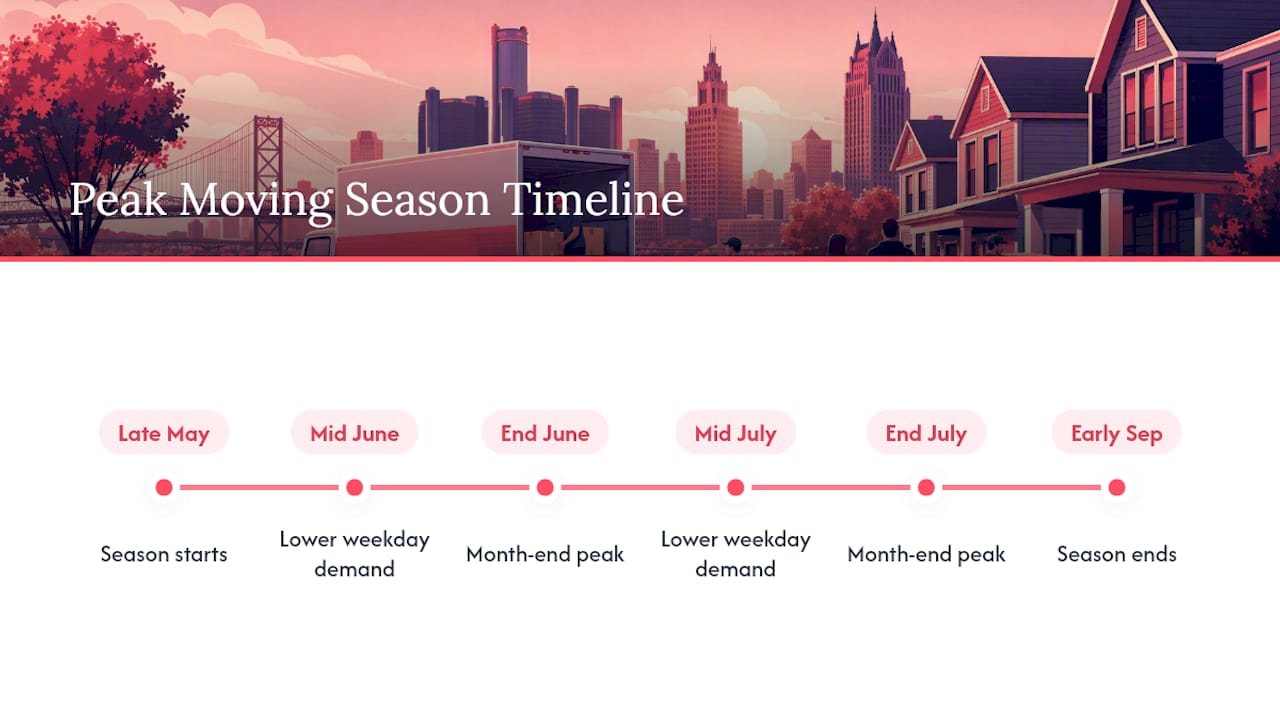
Peak moving season in Metro Detroit runs from late May through early September, the same window that dominates moving demand nationally. Within that stretch, the last weekend of the month and the first weekend of the next are consistently the busiest, since most leases turn over on the first. If your move date has any flexibility, a mid-month weekday move can mean a shorter wait for a crew and sometimes a better rate.
Certain Detroit neighborhoods also carry practical, if unofficial, restrictions tied to street width and parking density. Historic districts like Boston-Edison and Indian Village have narrow streets lined with mature trees, which limits how large a truck can maneuver without a permit or a police escort for oversized vehicles. Calling ahead to confirm truck size limitations before your movers show up with a 26-foot box truck saves everyone a frustrating morning.
Managing Parking and Traffic on Detroit Moving Day
Parking is where a lot of Detroit moves go sideways, especially in denser neighborhoods like Corktown, Midtown, and downtown proper. Street parking that’s wide open on a random Tuesday afternoon can vanish entirely if there’s a Tigers game, a festival, or road construction nearby, all of which are common enough in the warmer months to plan around.
Call your city council district office or check with your building management about temporary “no parking” permits if you need the street in front of your building cleared for a moving truck. These permits typically need to be requested several days ahead, and posting them the night before gives your neighbors fair warning instead of a shouting match on move morning.
Traffic timing matters more than most people expect. Avoid scheduling your truck’s arrival during rush hour on major corridors like Woodward Avenue, Gratiot, or the I-94 and I-75 interchanges, since a truck stuck in gridlock burns paid crew hours you’re footing the bill for. A mid-morning start, after the commute clears but before lunch traffic builds, tends to work best for both loading and unloading legs of the trip.
If your new home is in a suburb like Sterling Heights, Royal Oak, or Warren, double-check whether the destination street has the same width and parking constraints as your Detroit departure point. Suburban streets are often wider, but subdivisions with strict HOA rules sometimes limit how long a moving truck can block a shared roadway.
Getting Rid of What You Don’t Need Before You Pack It
The cheapest item to move is the one you don’t own anymore. Before a single box goes into the truck, sort everything into sell, donate, or toss, and be honest about what’s actually worth the effort of listing online versus what should just go straight to donation.
Detroit has solid donation infrastructure if you know where to look. Goodwill operates multiple donation centers across the metro area, and Habitat for Humanity’s ReStore locations accept gently used furniture and building materials, which is a better outlet than the curb for anything structurally sound. For clothing and household goods, local churches and community centers throughout Wayne County often run donation drives, particularly useful if your move falls near a seasonal clothing swap.
For anything genuinely unusable, check your city’s bulk trash pickup schedule well before your move, since Detroit’s Department of Public Works runs bulk collection on specific days by district, not on demand. Miss the scheduled pickup window and you’re stuck storing junk furniture for weeks or paying a hauling service out of pocket.
One practical note: donation receipts count as tax-deductible if you itemize, so keep them in the moving binder you started back in the 8 to 6 week window. It’s a small thing that pays off every April.
What Actually Matters Most in a Detroit Move
Most moving guides read like they were written for anywhere, then had “Detroit” pasted into the title. The advice that actually holds up here is narrower and more mechanical: verify your mover’s CVED or USDOT number, lock in DTE and DWSD activation the moment you have a date, and get parking or loading access confirmed in writing rather than a verbal promise from a building manager who won’t be on shift when the truck shows up.
Where conventional advice falls short is winter. Most checklists treat cold weather as a footnote, when it’s actually a scheduling variable that deserves its own line item, buffer days, floor protection costs, and a real conversation with your mover about how they handle ice and snow.
If you take one thing from this guide, prioritize verification over convenience. A mover with a real license and a written estimate after an actual walkthrough will cost you the same, sometimes less, than a phone-only quote from an unverified outfit, and the downside risk isn’t close.
— Bryan
Sources
- MoveBuddha — Movers in Detroit
- Detroit Water and Sewerage Department customer service — turn on/transfer water service
- MovingRated — Moving to Detroit (costs, neighborhoods, movers 2026)
FAQ
What Is a Good Moving Checklist?
A good moving checklist works backward from your move date in time blocks: 8 to 6 weeks out for booking movers and decluttering, 4 to 3 weeks out for utilities and access permits, 2 to 1 weeks out for packing and final confirmations, then move day and post-move administrative tasks.
What Should I Know Before Moving to Michigan?
You’ll need to register your vehicle and update your driver’s license through the Michigan Secretary of State within 30 days of establishing residency, and utility setup runs through separate providers, DTE Energy for gas and electric, DWSD for water in Detroit proper.
Why Are People Moving Out of Detroit?
Reasons vary by household, but common factors include seeking lower property taxes in surrounding counties, pursuing specific school districts, or relocating for job opportunities in the suburbs, while many others are moving into Detroit for its housing affordability compared to nearby metros.
How Far in Advance Should I Book Detroit Movers?
Book 4 to 8 weeks in advance, and lean toward the earlier end of that window if your move falls between May and September, when demand peaks across Wayne, Oakland, and Macomb counties.
Do I Need a Permit to Park a Moving Truck in Detroit?
Some Detroit neighborhoods and apartment buildings require a temporary loading permit or advance elevator reservation, so contact your building manager or local city office in writing before move day rather than assuming street parking will be available.