

TL;DR
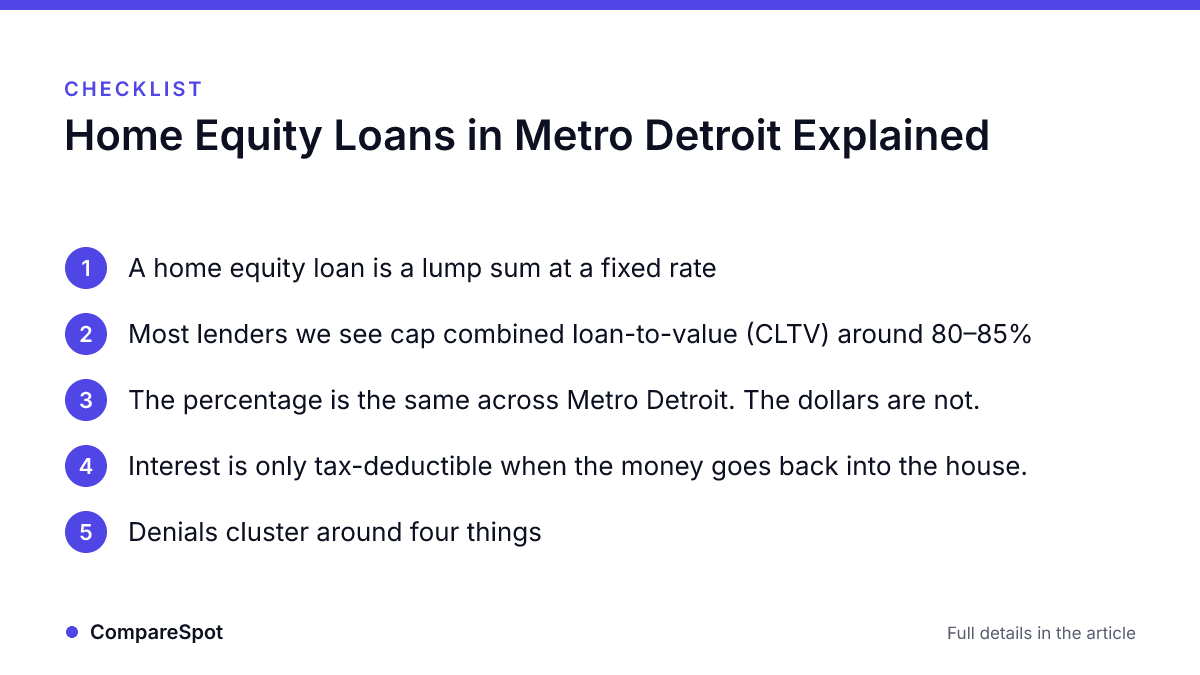
- A home equity loan is a lump sum at a fixed rate, repaid in equal monthly installments over roughly 5 to 30 years. A HELOC, by contrast, is a revolving line you draw against at a variable rate.
- Most lenders we see cap combined loan-to-value (CLTV) around 80–85%, so your first mortgage plus the new loan has to fit under that share of the appraised value.
- The percentage is the same across Metro Detroit. The dollars are not. 80% CLTV on a modest east-side bungalow and 80% on a Corktown rehab produce wildly different checks.
- Interest is only tax-deductible when the money goes back into the house. Consolidating credit cards with it doesn't qualify.
- Denials cluster around four things: thin equity, a stretched debt-to-income ratio, a credit score under the lender's floor, and an appraisal that comes in short.
A home equity loan lets you borrow against the value you've built in your house and take it as a single lump sum, repaid in fixed monthly installments, usually at a fixed rate over a term of 5 to 30 years, according to the Consumer Financial Protection Bureau's explainer on how home equity loans work. It's a second mortgage. Your house is the collateral, which is why the rate beats a credit card and why missing payments carries consequences a credit card never will.

Table of Contents
- How does a home equity loan work?
- What's the difference between a home equity loan and a HELOC?
- Do I qualify for a home equity loan?
- What disqualifies a home equity loan application?
- How much equity can you actually borrow?
- What should I expect to pay each month?
- Is a home equity loan tax deductible?
- How do people actually use home equity in Detroit?
- Frequently Asked Questions
How does a home equity loan work?
The lender funds the full amount in one deposit at closing, and repayment starts right away. Principal and interest come as one fixed bill that doesn't move when the prime rate does.
Amount, term, and rate are all locked at closing. That's the appeal for Metro Detroit homeowners who already know the number they need: a full kitchen gut, a tear-off roof, a furnace and ductwork replacement. One known expense, one fixed payment.
Underwriting looks a lot like your first mortgage. Income verification, a credit pull, a valuation, and a title search to confirm you actually own what you're pledging.
Pro tip: ask on the first call whether the lender is ordering a full interior appraisal or running an automated valuation model. In our experience an AVM clears in days, while a full appraisal in Detroit adds two to three weeks and a few hundred dollars (typically in the $400 to $600 range) to your costs. On older Detroit housing stock, appraisers frequently want inside, so budget the time.
What's the difference between a home equity loan and a HELOC?
A home equity loan hands you a fixed lump sum at a fixed rate. A HELOC gives you a revolving credit line at a variable rate that you draw from as needed, more like a credit card attached to your house.
The HELOC versus home equity loan question really comes down to one thing: do you know the exact amount today, or will you spend it in stages over the next few years?
| Feature | Home Equity Loan | HELOC |
|---|---|---|
| How you get funds | One lump sum at closing | Draw as needed during the draw period |
| Interest rate | Fixed for the life of the loan | Variable, tied to an index |
| Monthly payment | Same amount every month | Changes with your balance and the rate |
| Best for | A single known expense (roof, addition) | Phased or uncertain costs |
| Repayment structure | Principal and interest from day one | Interest-only during draw, then repayment |
| Rate risk | None after closing | Payment rises if the index rises |
Pro tip: financing a phased project (electrical panel this year, kitchen next year)? A HELOC usually costs less, because you're not paying interest on money parked in your checking account waiting for a contractor who's booked until spring.
Do I qualify for a home equity loan?
Qualification comes down to credit score, debt-to-income ratio, available equity, and how you've handled the mortgage you already have. Here's what lenders around here consistently look for:
- Credit score: 620 is a common floor. Pricing improves noticeably once you're in the high 600s and above.
- Combined loan-to-value: usually capped at 80–85%, counting your existing mortgage balance.
- Debt-to-income ratio: most want total monthly debts, including the new payment, at or under roughly 43% of gross income.
- Payment history: late mortgage payments or a delinquent property tax bill in the last year or two will sink an application that otherwise has plenty of equity behind it.
- Stable income: two years of it. Self-employed borrowers need returns, not bank statements and optimism.
A home equity loan with bad credit isn't impossible, but expect a higher rate, a tighter CLTV cap (think 70% instead of 85%), and sometimes a co-signer. Michigan credit unions and community banks tend to be more flexible here than the national lenders, partly because they know the neighborhoods and aren't working off a map that treats all of Wayne County as one risk bucket.
What disqualifies a home equity loan application?
Thin equity, a stretched debt-to-income ratio, a recent bankruptcy or foreclosure, and a low appraisal. That last one does the most damage in Detroit, where two similar houses a mile apart can appraise very differently depending on what's sold nearby in the last six months. If the value doesn't support your request, the lender shrinks the offer or walks.
Other things that stall files:
- A recent job change or employment gap, even when the new income is higher.
- An open collection or a 30-day late on any account in the past year.
- An existing second lien that pushes CLTV past the cap before your new loan is even counted.
- Unpermitted work. A finished basement or a rear addition with no permit history gets flagged by the appraiser and can freeze the file until the city sorts it out.
How much equity can you actually borrow?
Here's the formula in plain words: appraised value, times the lender's CLTV cap, minus what you still owe. What's left is your ceiling.
Run an illustrative scenario. Your house appraises at $95,000 and you owe $40,000 on the first mortgage. At an 80% cap:
$95,000 × 0.80 = $76,000 total allowed debt $76,000 − $40,000 = $36,000 available
Now the same $40,000 mortgage on a renovated home in Corktown, where values run several times the citywide median, appraised at $470,000:
$470,000 × 0.80 = $376,000 $376,000 − $40,000 = $336,000 available
Identical equity percentage, nearly ten times the borrowing power. Where the house sits matters as much as how long you've owned it. If you want a read on what price points actually buy across different areas right now, our guide to what $200K buys in Detroit breaks it down block by block, and the same cost-of-living and housing data is worth skimming before you set expectations.
What if the house is paid off? The subtraction step disappears. That same $95,000 home free and clear supports roughly $76,000 at an 80% cap, less closing costs, assuming income and credit hold up.
What should I expect to pay each month?
Rates move with the broader market and vary by lender, credit profile, and CLTV, so nobody can quote you a real number in an article. What you can do is run the payment math yourself the minute you get a quote.
Take the $36,000 from the example above. Plug in 8.5% purely as a placeholder:
- 15-year term: about $355/month. Total paid: $355 × 180 = $63,900, meaning roughly $27,900 in interest.
- 10-year term: about $446/month. Total paid: $446 × 120 = $53,520, meaning roughly $17,500 in interest.
That extra $91 a month buys back more than $10,000. My rule of thumb: take the shortest term where the payment still leaves you comfortable in a bad month, because a home equity loan payment is not one you can call and renegotiate.
Two practitioner notes on shopping rates. First, credit unions serving Wayne, Oakland, and Macomb counties routinely price under the national banks, and many will let you join with a small deposit the same day you apply. Second, compare the fee sheet, not just the rate. Some lenders waive appraisal and title fees but add a prepayment clawback if you pay off inside three years. Ask for that in writing before you sign.
Is a home equity loan tax deductible?
Only when the proceeds buy, build, or substantially improve the home securing the loan, per IRS rules summarized in Bankrate's and Rocket Mortgage's guidance on the topic. Pay off credit cards or a tuition bill with the exact same loan and the interest isn't deductible.
Keep the paper. Contractor invoices, permits, card statements for materials. "I'm pretty sure it went toward the roof" is not a records policy.
How do people actually use home equity in Detroit?
A handful of patterns come up over and over:
- Major repairs on older housing stock. Foundations, roofs, furnaces, galvanized plumbing. Tapping equity at a mortgage-adjacent rate beats a 20%+ personal loan on a $25,000 repair.
- Clearing a property tax arrearage before it becomes a foreclosure clock, usually for homeowners who don't qualify for the city's Homeowners Property Exemption (HOPE) program but are behind anyway.
- Adding square footage or an ADU, most often in suburbs like Hazel Park and Oak Park, where market forecasts for Metro Detroit suggest renovation dollars have a better shot at coming back at resale.
- Covering costs on an inherited property being transferred between heirs, which often runs alongside probate on a Detroit house.
- Buying out an ex-spouse's share in a divorce rather than listing the house.
One honest caveat. If the repair list has outgrown the equity, borrowing against a house that needs six figures of work is how people end up underwater on a home they can't finish. Price out an as-is sale first and see what that route nets after fees before you sign for a second lien.
Frequently Asked Questions
What is a HELOAN?
Industry shorthand for a home equity loan: the fixed-rate, lump-sum product, as opposed to a HELOC's revolving line. You'll mostly see it in lender marketing and comparison tools.
What disqualifies you from getting a home equity loan?
Usually insufficient equity after the new loan, a debt-to-income ratio above roughly 43%, a score below the lender's minimum (commonly 620), a recent bankruptcy or foreclosure, or an appraisal that lands under the value you assumed.
Does a home equity loan affect my property taxes?
No. Michigan taxes are based on assessed and taxable value, not what you owe. Your effective property tax rate in Detroit works out the same whether the house is free and clear or carrying two loans. A permitted addition funded by the loan can move your assessment, though. The improvement does that, not the borrowing.
Start this week: pull your current mortgage statement, look up three recent sales on your block, and request Loan Estimates from one national bank, one local credit union, and one Michigan mortgage lender. Lay the three fee sheets side by side. The spread is almost always wider than people expect, and comparing them costs you one afternoon. If the numbers say selling makes more sense than borrowing, get two as-is offers in hand before you decide.