

TL;DR
- A commercial real estate agent represents buyers, sellers, landlords, or tenants in deals involving income-producing property: office, retail, industrial, land, and apartment buildings of five units or more. In Michigan they operate under a real estate license issued by LARA, with brokers able to run their own shop and salespersons working under one.
- Commercial commissions around Metro Detroit generally land in the 4–6% range, calculated on sale price or on total lease value, and usually split between the listing side and whoever brings the buyer or tenant.
- Lease commissions are figured on the entire term, not one year. 5,000 square feet at $18 per foot on a five-year lease is $450,000 of lease value, which at 5% creates a $22,500 commission pool.
- Vet an agent on closed deals in your exact property type and submarket over the last 24 months. Career-long sales volume tells you almost nothing about whether they can underwrite your deal.
- The steadiest activity we see runs through Corktown, Midtown-New Center, Downtown, and the Warren-Sterling Heights industrial corridor.
If you hired a residential agent to sell your Ferndale bungalow and you're about to hand that same person a 20,000-square-foot warehouse lease in Warren, stop. Commercial property runs on different math, different contracts, and a different kind of agent.
Table of Contents
- What is a commercial real estate broker?
- How is a commercial agent different from a residential agent?
- How do commercial agents get paid in Metro Detroit?
- What licensing and credentials should you check for?
- How do you choose the right commercial agent for your deal?
- Where is Metro Detroit's commercial market strongest right now?
- What's your next move?
- Frequently asked questions
What is a commercial real estate broker?
A commercial real estate broker is a state-licensed professional who represents buyers, sellers, landlords, or tenants in transactions involving property used to make money: office buildings, retail centers, industrial sites, apartment buildings with five or more units, and land zoned for development. Most of them specialize further. Industrial leasing and multifamily investment sales share a license category and not much else, because each asset class has its own leasing norms, its own lenders, and its own buyer pool.
In Michigan the word "broker" carries a specific legal weight. A broker has passed the higher-level exam and met additional experience requirements, which lets them run a brokerage and supervise other licensees. A salesperson or associate broker holds a license but works under a broker's supervision. Both can legally handle commercial deals. You'll just notice that the title "broker" tends to sit next to the names closing the larger transactions downtown and in Corktown.

How is a commercial agent different from a residential agent?
Commercial agents sell cash flow and risk. Residential agents sell a place to live. That one difference reshapes the entire job. A residential agent markets curb appeal, runs showings, and negotiates around a home inspection and an appraisal tied to comparable sales down the street. A commercial agent has to underwrite the property the way a lender will: build a pro forma, calculate net operating income, back into a cap rate, and model what happens to value when a tenant vacates in year three.
| Factor | Residential agent | Commercial real estate agent |
|---|---|---|
| Primary value metric | Comparable sales, price per square foot | Net operating income, cap rate, cash-on-cash return |
| Typical client | Homeowner or first-time buyer | Investor, business owner, developer, fund |
| Deal complexity | Standard purchase agreement, inspection, appraisal | Custom leases, NNN terms, zoning, environmental review |
| Transaction timeline | Roughly 30 to 45 days to close | Commonly 60 to 180 days, longer on value-add deals |
| Licensing path | Salesperson license, often part-time | Broker or associate broker, usually a full-time specialist |
| Commission basis | Percentage of sale price | Percentage of sale price or of full lease value over the term |
Selling a house in Royal Oak? Hire the specialist who knows your block. Buying a strip center or leasing industrial space off Mound Road? Hire someone who has underwritten dozens of comparable deals and can walk a commercial lender through the rent roll without flinching.
How do commercial agents get paid in Metro Detroit?
Commission, almost always. In our experience the number typically falls in the 4–6% range of the sale price on a purchase, or of total lease value on a lease, then splits between the listing broker and the agent who delivered the buyer or tenant. The part that surprises people: lease commissions are calculated on the entire term, not a single year's rent.
Here's the arithmetic on a scenario we see constantly. A small business owner leases 5,000 square feet of retail space in a Jefferson-Chalmers storefront at $18 per square foot per year on a five-year term.
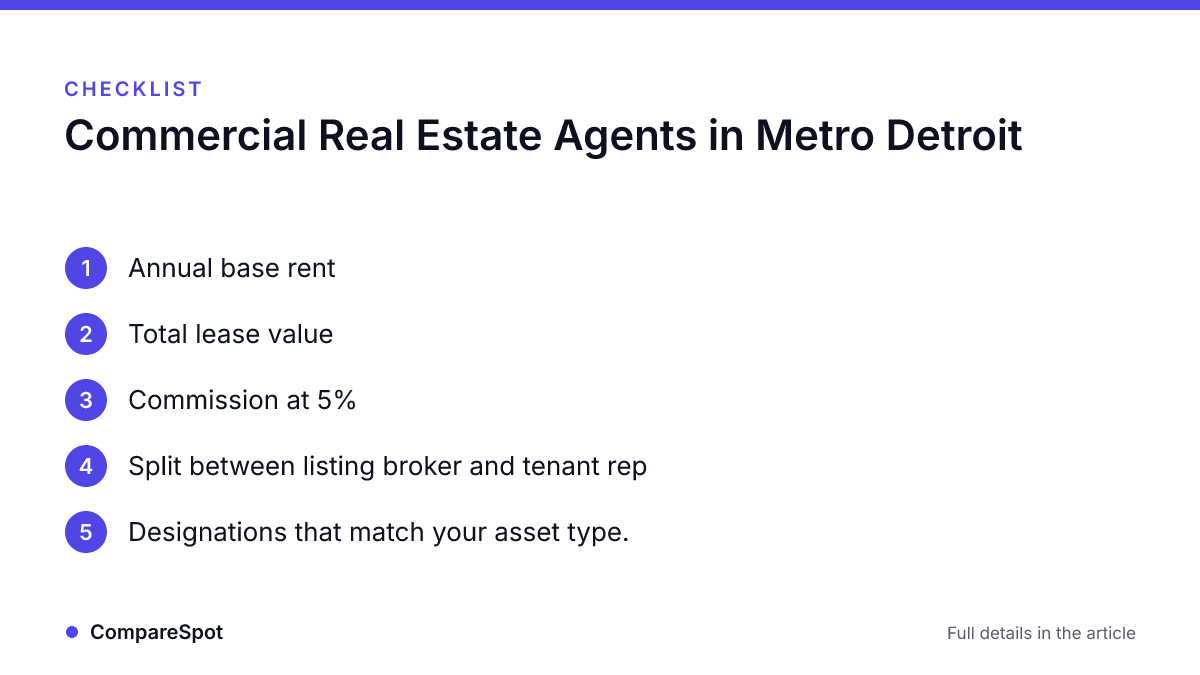
- Annual base rent: 5,000 sq ft × $18/sq ft = $90,000 per year
- Total lease value: $90,000 × 5 years = $450,000
- Commission at 5%: $450,000 × 0.05 = $22,500
- Split between listing broker and tenant rep: $11,250 each
Run that same formula on your own numbers. Square footage times rate times years times commission rate, then halve it if there are two brokers. On a sale it works identically against the purchase price: a $1.2 million office building at 5% produces a $60,000 commission pool.
Two details that move real money. First, confirm whether commission is calculated on base rent alone or on gross rent including CAM, taxes, and insurance. That $18 NNN rate might carry another $5 to $7 per foot in operating expenses, and whether those dollars count toward the commission base is a negotiable line in the listing agreement. Second, ask whether escalations are included. A 3% annual bump across five years adds real value to the lease total.
Pro tip: ask upfront who writes the check. In most Metro Detroit deals the landlord or seller pays both sides, but some tenant representation agreements shift a slice to the tenant if the landlord won't cooperate. Get the answer in writing before you tour a single building.
What licensing and credentials should you check for?
Every commercial real estate agent working in Michigan needs an active license from LARA, and whoever runs the brokerage needs a broker's license specifically. Verify it yourself through the state's licensing lookup instead of trusting a business card. Then look past the baseline.
- Designations that match your asset type. CCIM coursework is built around investment analysis and matters most on an income-property purchase. SIOR is the industrial and office leasing credential. Neither is mandatory, and plenty of excellent brokers carry neither, but both require documented transaction volume that residential-only agents don't accumulate.
- Who holds the broker's license above your agent. National platforms and independent local shops both close good deals in this market. You just want to know the name of the broker of record and be able to reach them if something goes sideways.
- Errors and omissions coverage. Bigger dollars, more legal exposure. Ask which carrier and what the limits are.
- Environmental experience, specifically. This is the Detroit question. Ask when they last ordered a Phase I, what the report flagged, and what they did next. Half the industrial and commercial parcels in this region sat under a machine shop, a gas station, or a dry cleaner at some point. An agent who has never walked a client through a Phase II or a Baseline Environmental Assessment is going to learn on your deal, and the learning window closes fast after you take title.
Pro tip: if the marketing leans hard on residential sales awards while the commercial closed list is thin, keep shopping. A bad underwriting assumption on a six-figure lease costs far more than a few weeks of interviewing brokers.
How do you choose the right commercial agent for your deal?
Choose on closed transactions in your exact property type and submarket, not on years in the business. An agent who has closed a dozen retail leases in Midtown-New Center knows the asking rents, the parking math, the landlords, and which buildings have a chronic HVAC problem. That beats a generalist with twenty years spread across every zip code between Monroe and Flint.
Ask these four questions, in this order:
- How many deals have you closed in this asset class in the last 24 months? Warehouse and storefront deals require different instincts, different comps, and different lenders.
- Walk me through one comparable deal you closed in this submarket. You want the actual rate, the actual concession package, the actual timeline. If they can't produce specifics, they didn't do the deal.
- Who's on your bench for due diligence? A real commercial agent already has a real estate attorney, a Phase I consultant, a surveyor, and two or three commercial lenders they can call the same afternoon.
- What else is in your pipeline right now? Twenty active listings means your deal gets whatever time is left over.
One more test: when an agent quotes you a rate, ask immediately whether it's gross or triple net. Anyone who hesitates on that question has no business negotiating your lease.
If you're also weighing the residential side of things, maybe you inherited a house along with a small commercial building, our guide on what $200K buys you in Detroit right now is a quick gut-check on current pricing across the metro.
Where is Metro Detroit's commercial market strongest right now?
The consistent activity we see sits in four places: Corktown, Midtown-New Center, Downtown, and the Warren-Sterling Heights industrial corridor. CLS Commercial Real Estate's Detroit market report is a reasonable cross-check if you want a second read on submarket momentum before you commit.
Corktown's draw is the Michigan Central campus redevelopment and the tech and retail tenants that have followed it in, a shift you can track through tenant-side listing platforms like TenantBase. Midtown has something more durable than momentum: Wayne State, the Detroit Medical Center, and the Detroit Institute of Arts anchor a few square blocks and keep daytime foot traffic steady regardless of the cycle. Downtown carries the deepest pool of available space across property types, which means more choice and more leverage for tenants who are patient. The Warren-Sterling Heights corridor is the opposite story: functional industrial space with clear height and dock doors moves fast, and the good buildings rarely sit.
Before you accept any quoted rate, make the agent produce three comparable deals that actually closed, with dates. Asking rents and signed rents are different numbers, and the gap between them is where your negotiation lives. Aggregators like CommercialSearch and Realmo's market analysis are useful for a rough sense of asking prices across the city, but treat them as a starting point rather than a comp set.
Landlords moving from residential rentals into commercial property usually need different management too. Our rundown of property management companies serving Metro Detroit covers who handles both sides competently.
What's your next move?
Build a shortlist of three agents who have closed deals in your exact asset class and submarket within the last two years. Verify each license through LARA, ask each one for a reference from a transaction that resembles yours, and ask all three the gross-versus-NNN question. The answers will sort them quickly.
Frequently asked questions
Can a residential real estate agent legally handle a commercial deal?
Yes. A standard Michigan real estate license covers both, and there's no separate commercial license. The legal answer and the practical answer differ, though. Most residential agents haven't negotiated a triple-net lease, read a Phase I, or checked a zoning classification against a client's intended use, and those are the three places commercial deals go wrong.
Is wholesale real estate the same thing as commercial real estate investing?
No. Wholesaling means tying up a property under contract at a discount and assigning that contract to another buyer for a fee, usually without ever closing yourself. Commercial investing means buying, leasing, or developing income-producing property directly, with different financing, different holding periods, and different exit math.
How much does a commercial real estate agent typically earn?
It's commission income, so it tracks deal size and deal flow rather than a salary. A single mid-size transaction like the $22,500 lease commission above can represent a meaningful chunk of an agent's year, which is exactly why experienced commercial brokers chase fewer, larger deals instead of high-volume small ones. It also explains why a good one will tell you a deal doesn't pencil: their reputation is worth more than one closing.