

Michigan imposes a state real estate transfer tax of $3.75 per $500 (or fraction thereof) plus a county transfer tax typically of $0.55 per $500, producing a combined rate of $4.30 per $500 of sale price. The seller (grantor) is liable under Michigan law, and payment must reach the county treasurer within 15 days of deed delivery.
Here is what that looks like in practice:
- State rate: $3.75 per $500 (or fraction)
- County rate: $0.55 per $500 (or fraction) in most counties; up to $0.75 in counties with populations of 2,000,000 or more
- Combined typical rate: $4.30 per $500, which equals $8.60 per $1,000 of sale price
- Who pays: The seller/grantor by statute; buyers sometimes cover it by agreement, but the legal obligation stays with the seller
- Deadline: Payment due to the county treasurer within 15 days of the instrument’s delivery date
Key Takeaways
Michigan’s real estate transfer tax is calculated per $500 increment of sale price, with the seller liable for the combined state and county amount due to the county treasurer within 15 days of deed delivery.
| Point | Details |
|---|---|
| Per-$500 rule with ceiling rounding | Divide sale price by 500, round up any fraction, multiply by $4.30 for the typical combined rate. |
| Combined typical rate | $3.75 state + $0.55 county = $4.30 per $500, or $8.60 per $1,000 of sale price. |
| 15-day payment deadline | Payment is due to the county treasurer within 15 days of the deed’s delivery date. |
| Exemptions and refunds available | MCL 207.526 lists common exemptions; retroactive refund claims are permitted via the Michigan Department of Treasury SRETT page. |
| Comparespot for local closing help | Comparespot ranks vetted Metro Detroit agents and cash buyers who manage transfer tax logistics at closing. |
Table of Contents
- How is Michigan’s transfer tax calculated?
- Current Michigan transfer tax rates and county variations
- Who pays Michigan transfer tax, and where does it go?
- What transfers are exempt from Michigan transfer tax?
- How transfer tax works when real and personal property are sold together
- Special situations: controlling-interest transfers, foreclosures, and probate
- Worked examples and how to verify an online calculator
- How to request a refund or correct an overpayment
- What Michigan homeowners often get wrong about transfer tax
- Comparespot helps Metro Detroit sellers find the right closing team
- Sources
- FAQ
How is Michigan’s transfer tax calculated?
The formula is straightforward once you understand the $500-increment rule. Tax is not applied to the raw dollar amount — it is applied to the number of $500 increments (or fractions) in the sale price, then multiplied by the per-increment rate.
The formula:
Number of increments = CEILING(Sale Price ÷ 500) State tax = increments × $3.75 County tax = increments × $0.55 Total tax = increments × $4.30
The rounding rule is the part most people miss. Any fraction of a $500 increment counts as a full increment. A sale price of $250,001 rounds up to 501 increments, not 500. That single dollar triggers an extra $4.30 in combined tax.
Step-by-step calculation:
- Take the full sale price from the purchase agreement.
- Divide by 500.
- Round up to the next whole number if there is any remainder (ceiling function).
- Multiply that number by $3.75 for the state portion.
- Multiply that same number by $0.55 for the county portion (verify your county’s rate first).
- Add both amounts for the total transfer tax due.
Current Michigan transfer tax rates and county variations
The state rate has been fixed at $3.75 per $500 since January 1, 1995, established under MCL 207.525. County rates are set separately under county authority, and most Michigan counties charge $0.55 per $500. The exception: counties with populations of 2,000,000 or more may charge up to $0.75 per $500 for the county portion.
| Rate Component | Per $500 | Per $1,000 Equivalent |
|---|---|---|
| State (all counties) | $3.75 | $7.50 |
| County (most counties) | $0.55 | $1.10 |
| Combined (typical) | $4.30 | $8.60 |
| County (high-population) | up to $0.75 | up to $1.50 |
| Combined (high-population max) | up to $4.50 | up to $9.00 |
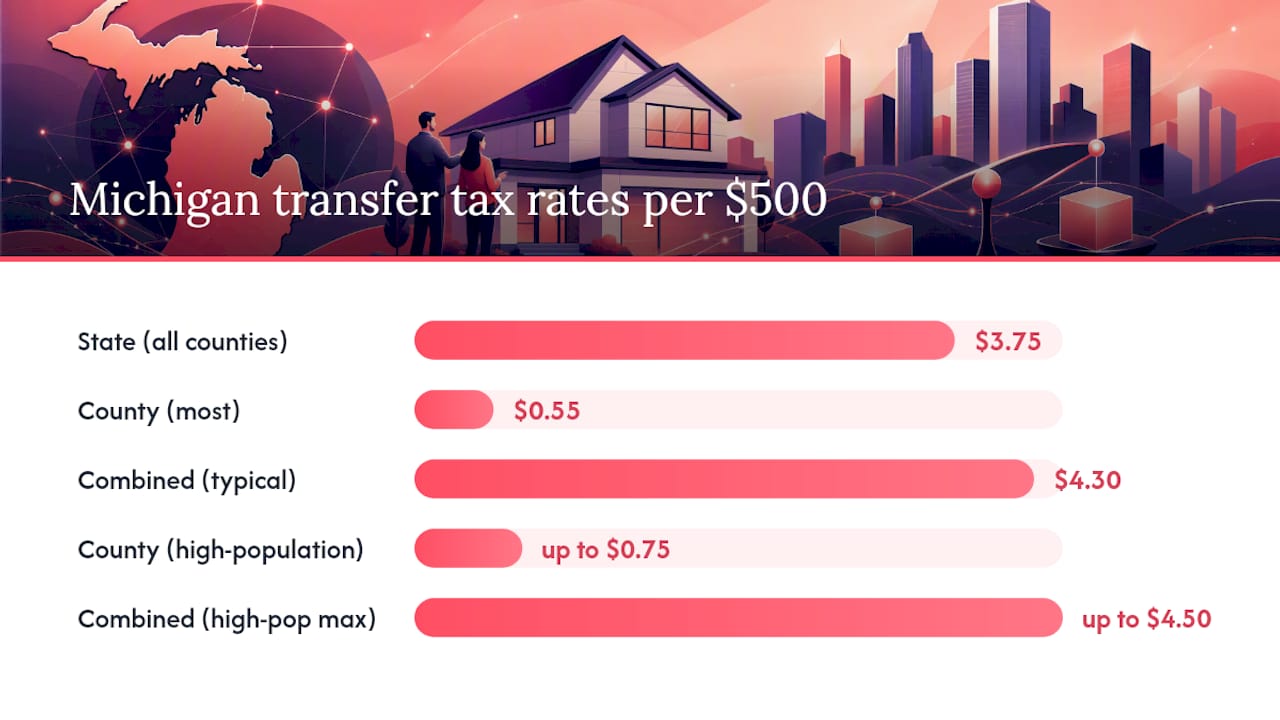
County rates do not change often, but they can differ. Many county register-of-deeds offices publish a transfer-tax fee table showing combined state-plus-county totals by price band, which is the fastest way to confirm what you owe locally. Before closing, check your county’s register of deeds or treasurer’s website directly. The St. Joseph County Register of Deeds and Ottawa County are two examples of counties that publish this information clearly online.
Who pays Michigan transfer tax, and where does it go?
MCL 207.523 names the seller (grantor) as the party legally liable for the transfer tax. In practice, purchase agreements sometimes shift the obligation to the buyer, but that is a contractual arrangement between the parties — the statute’s liability stays with the seller regardless of what the contract says.
Payment goes to the county treasurer in the county where the property sits. The 15-day deadline runs from the date the instrument (typically the deed) is delivered. Michigan law presumes the date printed on the instrument is the delivery date, so a deed dated March 15 starts the clock on March 15.
Practical payment steps:
- Bring the signed deed and a completed Transfer Valuation Affidavit (often called Form 2766 or a county-equivalent form) to the county treasurer’s office
- Pay the combined state and county tax at the same time; the treasurer collects both
- The treasurer stamps or receipts the deed, which the register of deeds then requires before recording
- Some counties allow payment at the register of deeds window directly; confirm with your specific county
The Transfer Valuation Affidavit is a separate, critical document. A missing or incomplete affidavit can delay deed recording and complicate how the tax is calculated. Bring it completed and signed to the closing or the treasurer’s office.
Pro Tip: If you are selling through a title company or real estate attorney, they typically handle the transfer tax payment at closing and will collect the funds from your proceeds. Still verify the amount yourself using the formula above before signing the settlement statement.
What transfers are exempt from Michigan transfer tax?
Several categories of transfers qualify for exemption under MCL 207.526. Claiming an exemption requires noting it on the deed or in an attached affidavit at the time of recording — you cannot simply skip payment and explain later.
Common exemptions include:
- Transfers where the total consideration is less than $100
- Court-ordered transfers made without monetary consideration (divorce decrees, partition orders)
- Transfers between a corporation or other entity and its owners upon dissolution, when no consideration passes
- Foreclosure-related transfers, including sheriff’s deeds and deeds in lieu of foreclosure (though subsequent transfers of the same property may be taxable)
- Transfers to or from a government entity
- Certain transfers between family members, depending on the circumstances and consideration paid
The Michigan Department of Treasury’s SRETT page hosts the refund forms and submission instructions. Processing typically takes several weeks after a complete application is received. If you paid tax on a transfer that clearly qualified for an exemption, a retroactive refund claim is worth filing.
For a detailed breakdown of Michigan transfer tax exemptions, Plante Moran’s published analysis covers the statutory categories with practical commentary on documentation requirements.
How transfer tax works when real and personal property are sold together
Selling a furnished rental property or a business with equipment alongside the real estate? The transfer tax applies only to the real property portion of the sale price, not to personal property like appliances, furniture, or machinery. The key is documentation.

Under MCL 207.525, if the instrument itself states the real and personal property values separately, or if an attached affidavit does so, the tax is calculated only on the real property value. Without that separation, the county may apply the tax to the full stated consideration.
How to document the allocation:
- State the real property value and personal property value as separate line items directly on the deed or purchase agreement
- Alternatively, attach a signed affidavit that breaks out each component with a clear description
- Keep the allocation consistent across all closing documents (purchase agreement, HUD/ALTA settlement statement, deed, and affidavit)
- Make sure the personal property list is specific enough to withstand scrutiny (serial numbers for appliances, an inventory list for furniture)
Pro Tip: Have your real estate attorney or title professional review the allocation language before the deed is drafted. A vague or inconsistent allocation is the most common reason county recorders question the stated consideration and recalculate the tax on the full sale price.
Special situations: controlling-interest transfers, foreclosures, and probate
Controlling-interest transfers
When someone transfers a controlling interest in an entity rather than the real property itself, Michigan’s transfer tax can still apply. If real property makes up 90% or more of the entity’s assets and a controlling interest (generally more than 50%) changes hands, the transaction is treated as a transfer of the real property for transfer-tax purposes. This rule prevents tax avoidance through entity-level sales.
Foreclosures and deeds in lieu
Sheriff’s deeds issued at foreclosure sales and deeds in lieu of foreclosure are generally exempt from transfer tax under MCL 207.526. The exemption is not automatic on all subsequent transfers, though.
Probate and gifts
Transfers through a probate estate to heirs or devisees often qualify for exemption when no monetary consideration passes. Gifts — transfers with no consideration — may also qualify under the sub-$100 consideration exemption or other MCL 207.526 categories. The specific facts matter: a transfer labeled a “gift” that involves assumption of a mortgage may still carry taxable consideration equal to the mortgage balance assumed. When in doubt, consult a Michigan real estate attorney before recording.
Worked examples and how to verify an online calculator
Three examples show how the arithmetic plays out across common sale prices.
Example 1: $185,000 sale $185,000 ÷ 500 = 370 increments (exact, no rounding needed) State: 370 × $3.75 = $1,387.50 County: 370 × $0.55 = $203.50 Total: $1,591.00
Example 2: $312,500 sale $312,500 ÷ 500 = 625 increments (exact) State: 625 × $3.75 = $2,343.75 County: 625 × $0.55 = $343.75 Total: $2,687.50
Example 3: $427,250 sale $427,250 ÷ 500 = 854.5 → rounds up to 855 increments State: 855 × $3.75 = $3,206.25 County: 855 × $0.55 = $470.25 Total: $3,676.50
The Riverbank Finance Michigan Property Transfer Tax Calculator is a widely used online tool for quick estimates. To verify any calculator’s output manually:
- Confirm the calculator is using $3.75 state and $0.55 county (or your county’s actual rate)
- Check whether it applies ceiling rounding or simple division — it should round up any fraction
- Compare its result to your manual calculation using the formula above
- Watch for calculators that use a flat per-$1,000 rate without rounding; they can understate tax on prices that are not clean multiples of $500
Understanding the hidden costs of selling with a Realtor in Michigan — including transfer tax — helps you budget accurately before listing.
How to request a refund or correct an overpayment
If you paid transfer tax on a transaction that qualified for an exemption, a refund is available. Here is the process:
- Gather your documents: the recorded deed, the county treasurer’s receipt showing tax paid, any affidavits filed at closing, and any court orders or dissolution documents relevant to the exemption claimed
- Identify the exemption basis: cite the specific MCL 207.526 subsection that applies to your transfer
- Complete the state refund form: download the current SRETT refund application from the Michigan Department of Treasury
- Submit to the Department of Treasury: mail or submit the completed form with all supporting documents to the address listed on the form; some county-level overpayments may be corrected at the county treasurer’s office directly
- Follow up: Treasury instructs filers to allow several weeks for processing; keep copies of everything submitted
Who can file: The seller (the party legally liable) or a buyer who paid on the seller’s behalf under a contractual arrangement can file the refund claim. The claim must clearly identify the transaction, the amount paid, and the exemption basis.
Contact points:
- Michigan Department of Treasury, SRETT refund unit (contact information on the Treasury SRETT page)
- County treasurer’s office where the tax was originally paid
- Local register of deeds for copies of the recorded instrument if needed
For sellers navigating the full cost to sell a house in Michigan, transfer tax is one of several closing costs worth tracking from the start.
What Michigan homeowners often get wrong about transfer tax
Most people treat the transfer tax as a fixed closing-cost line item and never look at it again. That is a mistake in three specific situations.
First, the allocation between real and personal property is almost always left undocumented. Sellers of furnished rentals or properties with significant personal property routinely pay transfer tax on the full sale price when a simple affidavit would have reduced the taxable base by thousands of dollars. The statute is clear on this point, but title companies do not always flag it proactively.
Second, the 15-day deadline is tighter than most sellers realize. If you are closing without a title company and handling the deed recording yourself, that clock starts on the deed’s date, not the recording date. Missing it does not void the transfer, but it creates a compliance issue that can complicate a future sale of the same property.
Third, the exemption categories under MCL 207.526 are broader than most sellers know. Inherited property, court-ordered transfers, and certain entity-level transactions frequently qualify, yet sellers pay the tax anyway because no one on the transaction team raised the question. When an exemption clearly applies, the refund process through the Michigan Department of Treasury is straightforward. File it. The forms are online, the process is documented, and retroactive claims are explicitly permitted by statute.
If you are dealing with an inherited property specifically, the guide to selling an inherited house in Roseville, MI covers the exemption and probate considerations in practical detail.
Comparespot helps Metro Detroit sellers find the right closing team
Transfer tax is one piece of a larger closing-cost picture, and having the right local professionals handle the paperwork makes a real difference. Comparespot independently ranks the top real estate agents in Metro Detroit and cash home buyers across the region based on verified customer sentiment and market performance, not paid placement. Agents in the rankings are experienced with Michigan’s transfer tax requirements, valuation affidavits, and county-specific filing procedures. Cash buyers often handle the full closing process, including tax payment, directly.

If you want to skip the paperwork entirely, Comparespot’s cash buyer rankings for Sterling Heights and surrounding areas list buyers who manage closing logistics from offer to deed recording. Browse the rankings at Comparespot and connect with a vetted local provider today.
Sources
For rates, statutes, forms, and county-specific filing requirements, these are the primary references:
- Michigan Real Estate Transfer Tax — Van Buren County Register of Deeds
- MCL - Section 207.523 - Michigan Legislature
- State Real Estate Transfer Tax (SRETT) — Michigan Department of Treasury
This article is general information, not a substitute for advice from a qualified financial advisor. Consult a qualified financial professional about your own circumstances before acting on anything here.
FAQ
What is Michigan’s real estate transfer tax rate?
The state rate is $3.75 per $500 (or fraction) of sale price; most counties add $0.55 per $500, producing a combined rate of $4.30 per $500, or $8.60 per $1,000.
Which states don’t have a real estate transfer tax?
Several states impose no transfer tax on real property conveyances, including Texas, New Mexico, Wyoming, North Dakota, Indiana, Louisiana, Mississippi, Missouri, and Montana, among others. Michigan does impose one at both the state and county level.
Is Michigan going to end property taxes?
No legislation has eliminated Michigan’s property tax or its real estate transfer tax. Proposals to restructure property taxation surface periodically in the Michigan Legislature, but both taxes remain in effect.
Who is legally responsible for paying Michigan’s transfer tax?
Under MCL 207.523, the seller (grantor) is the party legally liable. Buyers sometimes agree by contract to cover the tax, but that agreement does not shift the statutory obligation away from the seller.
How do I claim a transfer tax exemption or refund in Michigan?
Note the applicable MCL 207.526 exemption on the deed or an attached affidavit at recording. If tax was already paid in error, download the SRETT refund application from the Michigan Department of Treasury, attach the recorded deed and county receipt, and submit the completed package to Treasury for processing.